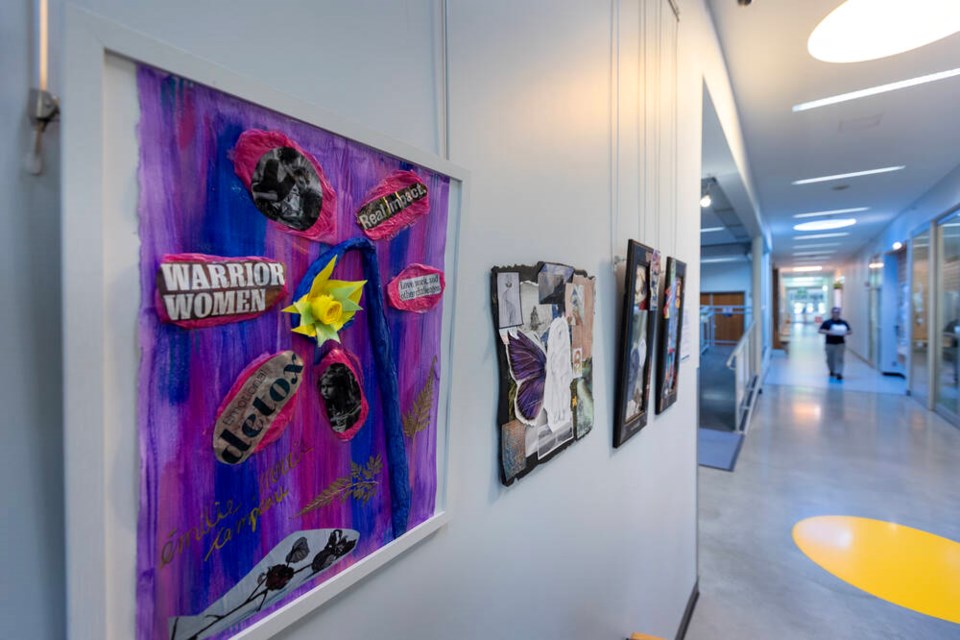
A three-dimensional yellow daffodil pops out of a pink and purple canvas painted by Emilie Morris-Campeau, a survivor of brain injury and intimate-partner violence.
She’s one of a handful of people with similar experiences who take part in an art-therapy program at the Cridge Centre for the Family.
Art pieces by women in the group are currently on display at the Cedar Hill Recreation Centre to shed light on the invisible disability of brain injury, in honour of National AccessAbility Week.
Morris-Campeau has been a member of the program for over a year and said it has made a huge difference in her journey to recovery.
“A lot of my healing has come through connecting with other people who understand,” she said, adding she experienced a feeling of companionship in the room without having to explain herself to the other women.
Morris-Campeau described the art-making process as peaceful and therapeutic — putting her into an almost trance-like state that has helped her reckon with her past experiences.
Some of the art pieces include mirrors, reflecting the idea that anyone can become disabled in the blink of an eye, said one of the program’s facilitators.
Support worker Kristen, a survivor who did not want to share her last name, said everyone in the group “has a story of destruction.”
“They’re rebuilding through creativity.”
Some of the women were hesitant to create at first, saying they were just attending the group to connect with others, but slowly came out of their shells after building trust with their peers, she said. “Being able to create after losing so much is amazing.”
She said the program started when two women came to her, asking for an artistic outlet to work through their trauma.
What started as a group that was using dollar-store art supplies in a community hall turned into a grant-funded program with its own space at the Cridge Centre, said Kristen.
But Kristen said they would be nowhere without the kindness of the women at the Victoria United Chapter Society, who gave money for the initial supplies and provided their meeting space as a venue.
Participants meet for two hours every week and try different art styles, like weaving and needlepointing.Lisa Blackwell, a practicum student at the Canadian International Institute of Art Therapy, was brought in to help facilitate the group in November.
Blackwell said it took time to foster a sense of trust within the group, noting some of the art pieces on display were created by more than one artist.
The hope is that participants take that sense of pride and bring it into their everyday lives, she said, especially if they’ve lost confidence as a result of their past experiences.
“The creative process within the group is one of self-expression, but it’s also just about creating,” said Blackwell. “It’s about not having an agenda.”
She said healing also comes from the tactile experience of working with different materials, especially when working on a piece with another person. The art can serve as a sort of middle-ground participant that helps two people connect, she said.
“I can see the catharsis,” she said, noting women in the group support each other on rough days.
The art program is funded by a grant through Disability Alliance B.C. and will continue at the Cridge Centre for as long as there is interest, said Kristen.
It’s part of the centre’s intimate partner violence and brain-injury program, created in 2020 and the first of its kind in Canada.
The two are more connected than many think. For every NHL player who gets a concussion, more than 7,000 Canadian women face the same injury at the hands of an intimate partner.
Kristen said brain injuries can happen when someone is hit or shoved, but also if they experience periods without oxygen while being choked by a partner.
Tori Dach, manager of brain-injury services at the centre, said the programs fill a gap for women who haven’t been formally diagnosed with a brain injury, which is required for most health-care-based supports.
She said there are lots of reasons why someone might not get a diagnosis, like mistrust, fear and shame.
For Morris-Campeau, the art-therapy program has helped her emerge from the isolation she had felt since the end of her abusive relationship. “It’s kind of like this old part of me has died,” she said. “It’s actually been quite life-changing.”