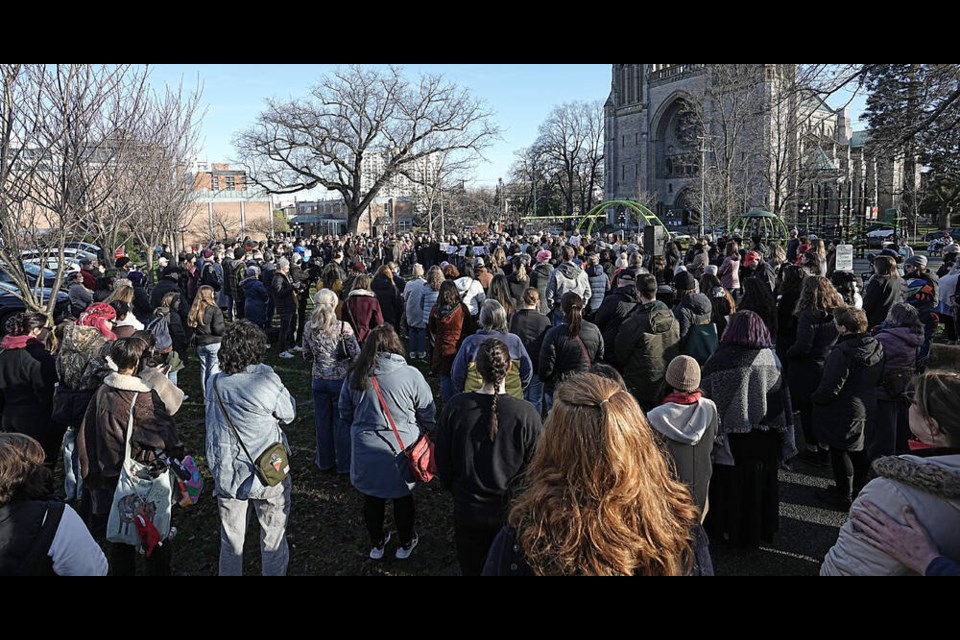
Dozens of people gathered outside the Victoria courthouse on Wednesday morning to demand urgent action on intimate-partner violence in the wake of the death of a 41-year-old college instructor.
Laura Gover, a mother of two, was found dead in her Saanich home on Jan. 5.
Her ex-partner has been charged with second-degree murder in her death.
Kelsea McLaughlin, a close friend of Gover, said the large turnout was fitting for her friend.
“Laura was someone who would have come to a community rally like this in support of others, and so to see community show up for her — both folks that knew her and people who didn’t — is really heartwarming,” she said.
McLaughlin said the frustration she heard from some in the gathering about gaps in the system that leave women vulnerable to violence was the “rallying cry we need” to act for those who have been lost.
Representatives from organizations in Victoria, the Cowichan Valley and Vancouver spoke at the rally about the need to take women’s fears seriously, and for the system to take responsibility to keep women safe.
“We want women to be believed when they say they’re afraid,” said Marlene Goley, manager of the Cridge Transition House and Outreach Services. “A woman’s fear is a risk factor that needs to be taken seriously.”
Women are being killed when the risk to their safety is already known, said Angela Marie MacDougall, executive director of Battered Women’s Support Services in Vancouver.
MacDougall called on governments to implement a province-wide standardized risk assessment, create municipal gender-based violence task forces, increase funding to front-line services by 15 per cent, launch a provincial public awareness and prevention campaign, and create a position in the provincial government that would focus on gender-based violence prevention.
She also called for mandatory coroner’s inquests into the deaths of women in cases where a protection order or peace bond had been granted. She said inquests would expose systemic gaps so they cannot be ignored or repeated.
Women believe that when they involve the criminal-justice or family-law systems, their risk will be reduced, MacDougall said, but “risk lives in the space between systems, and no one owns that space.” That leaves women unprotected, she said.
MacDougall said a standardized risk assessment for police, Crown counsel, courts, child-protection agencies and family law would identify dangers early and allow authorities to act consistently.
The provincial government has committed to implementing standardized risk assessments, but there are no timelines for the work, she said.
“Commitments without deadlines become delay. And women die in that space,” she said.
Diana Gibson, MLA for Oak Bay-Gordon Head, attended the event and said she heard the concerns raised about timelines and will take those to the attorney general.
Gibson said she has been reaching out to police, community members and agencies that work with victims of intimate partner violence in the wake of Gover’s death to identify what can be done to better protect women.
“It’s really important to look at this case and others to ensure we are closing every gap we can and identifying things we can learn,” she said.
B.C. Attorney General Niki Sharma said in an interview that the province is working on creating standardized risk assessments and plans to bring together relevant parties to determine when and how they should be conducted.
“When [women] are coming forward to say ‘this person’s hurting me, and I want the system to protect me,’ it needs to be there to protect them,” she said.
Sharma has advocated for several changes to Canada’s Criminal Code, including classifying homicides of an intimate partner that involve a pattern of coercive or controlling conduct as first-degree murder, and stricter bail conditions to prevent retaliatory violence following criminal charges.
Second-degree and first-degree murder are both deliberate killings, but to be considered first-degree, a homicide must also be planned, with some exceptions that are automatically designated first-degree murders.
Those exceptions include killing an on-duty police officer or prison employee; a killing committed during a hijacking, sexual assault or kidnapping, or while committing a terrorist act; a killing for the benefit of a criminal organization, or if the person is committing criminal harassment to cause the victim to fear for their safety.
In December, the federal government tabled Bill C-16, the Protecting Victims Act, to protect victims of sexual, gender-based and intimate partner violence. Among the proposed changes is treating murders involving control, hate, sexual violence or exploitation as first-degree murder and defining them as femicide when the victim is a woman.
Intimate partner violence and bail issues were brought to the forefront last year when a Kelowna man was charged in the killing of his estranged wife.
James Plover had been convicted on a separate assault charge and was out on bail awaiting sentencing when Bailey McCourt was killed on July 4, 2025.
Gibson said constituents who would like to connect on the issue of intimate partner violence can email her at diana.gibson.mla@leg.bc.ca.
Muhammed Ali Basar, who turns 47 this year, has been charged with second-degree murder in connection with Gover’s death. He was scheduled to appear in court on Wednesday afternoon.